

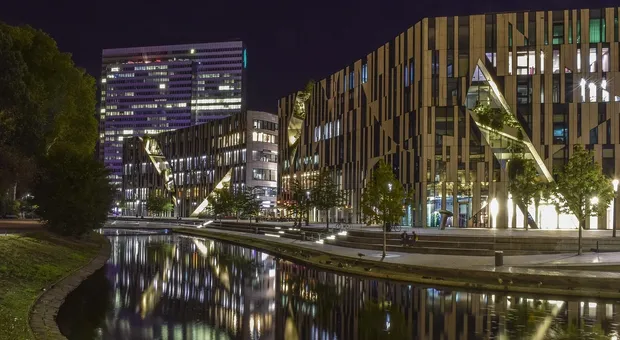
Offices, improving lighting increases productivity levels
There are many factors that can influence productivity in the workplace, and of all of these, one which is always present is the lighting. An element that often seems to be underestimated by companies.
Although there is no shortage of large companies that have equipped their offices with cutting edge lighting systems, generally speaking, the illumination of the workplace is often not assigned the importance it deserves. For example, a recent study performed by the American Society of Interior Design has revealed that 68 per cent of employees are not satisfied with the lighting in their offices. And another survey, conducted in Italy by Asso ufficio, confirms these results.
Two of the most common symptoms of a badly-lit office are a dim workspace and an annoying light.

An office illuminated with LED Panel (Disano)
When speaking of the amount of light, we must consider the fact that indoor lighting is the result of different components, including the natural lighting coming from windows, skylights and French doors and the ambient lighting from direct sources (ceiling-mounted lamps) or indirect sources (wall-mounted lamps) as well as the local lighting used in workspaces. The best conditions are obtained with an ambient lighting ranging between 300 and 500 lux; weaker values bring about a gradual reduction in performance and therefore an increase in the number of potential errors. It is important to balance the environmental illumination present with local and focused lighting in order to reduce the contrasts between shady areas and zones with better lighting.


A meeting room illuminated with Comfort LED (Disano) UGR<19
For the quality of light, there is a precise benchmark, that of natural light. Many studies have shown that exposing workers to a good quantity of light from the windows in the workplace has a positive effect on their health and mood. However, it is not always possible to use rooms with a good amount of natural light and it is even more difficult to guarantee this in all seasons and for all workstations.
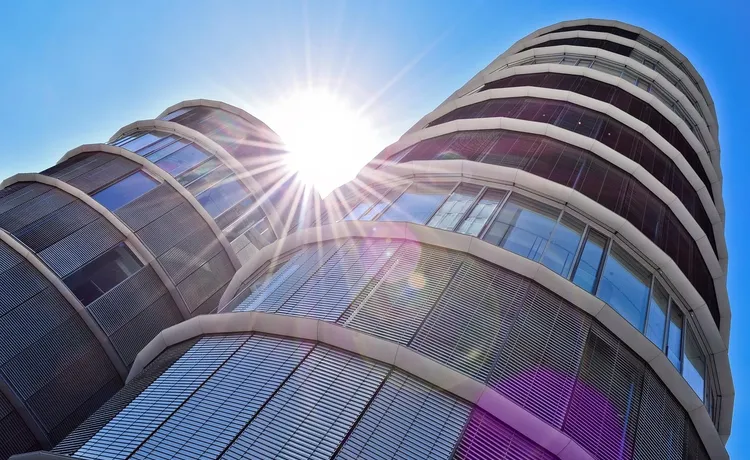
With the new LED lighting systems, much can be done to achieve a good quality of lighting that increasingly resembles that of natural light.
The latest LED sources have a high colour rendering index, meaning not only that it is easier to see objects, but also that the levels of visual comfort are improved. A simple daylight sensor can regulate the artificial light based on the quantity of natural light present, to ensure a constant illumination level. These regulation systems then open up a whole series of other possibilities, including that of regulating light intensity by mimicking the rhythms of natural light during the day.
Other factors, such as light stability, can be achieved by minimizing flicker, which is an undesired effect that can be annoying or even unsafe for workers’ health. Another phenomenon to keep under control is glare that should be reduced as much as possible, especially in rooms with computer monitors. Today, the latest lighting devices must have low flicker and glare levels, also to comply with the laws on lighting in the workplace, which have recently become stricter.
And the picture would not be complete without mentioning the energy saving achieved with the new LED systems. It therefore pays dividends to turn on a new light in the office, in more ways than one.
Related posts:




- Posted by Redazione
- On March 17, 2017
- 0 Comments
- 0 likes
Leave Reply