

HCL to improve the quality of life at all ages
A peaceful and healthy old age also needs the right lighting. It might sound unimportant, yet if we think of all the consolidated research conducted on the effects of lighting on our biological clock, it is safe to say that it is time we try to learn more about the type of lighting that affects us in our everyday life.
This is what the researchers of the lighting laboratory of the Politecnico di Milano are examining through a study that aims to collect data on residential lighting, both natural and artificial, in terms of sustainability, energy efficiency and people’s wellbeing. An important part of the study is focused on people over 65 years, a population doomed to increase in the next following years in an aging continent like Europe.
As years go by, we tend to spend more time at home, increasing our exposure to artificial lighting. But are we really sure that the lights in our homes are the best for our wellbeing? The answers – or at least some of them – will come from the results of this research, presented at the latest annual conference of Assil, the National Association of Lighting Manufacturers.
Based on the knowledge acquired on the circadian rhythm, i.e. our internal biological clock that governs our vital functions and that is activated by different lighting conditions, the researchers at the Politecnico (Maurizio Rossi, Daria Casciani, Fulvio Musante) are studying the type of lighting in different environments of the house and the habits of those inhabiting them.
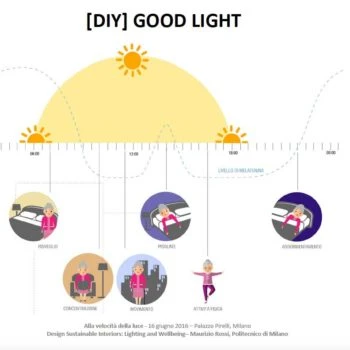
In the various hours of the day (and of the seasons) we spend a variable amount of time in different environments of our home: in fact, the bedroom, living room and study are the rooms where the conditions of natural and artificial light vary throughout the day. By studying different types of lighting, we can discover the ones that are best for us when we wake up, go to sleep, concentrate and carry out all the other daily activities.

The research of the Politecnico di Milano, funded by the ENEA institute and the Ministry of Economic Development, aims to assess the possibility of supplementing residential lighting with the most advanced lighting control systems. The future – as well as the present – of the Internet of Things (IoT) offers energy-efficient solutions to have better lighting conditions for our body, in all residential environments during different times of the day.
What are we actually talking about here? In detail, we mean a series of sensors (presence detectors, radars, wearable sensors) and individual control systems, such as Apps for tablets or smartphones, that can control (automatically or manually) lighting fixtures and sources through Wi-Fi systems. With these tools, we can programme or manually modify lighting settings based on the needs of our body: awakening, concentration , relaxation, and sleeping.

We are in the realm of Human Centric Lighting (HCL), an increasingly important topic in the lighting world, so much as Lighting Europe (the association of the European lighting industry) indicated HCL as one of the driving principles of the sector’s growth over the next ten years.
With a right HCL plan, lighting can turn into an element to help us during all the moments of our lives, from work to relaxation to leisure.
It is a complex system that can be made possible with the technologies currently available. The lighting industry is confident. In its Strategic Roadmap 2025, Lighting Europe indicated a series of actions to promote HCL, including the development of education and information campaigns to explain the benefits of HCL to consumers and public administrators, a strategic alliance with the association of manufacturers, the creation of regulatory instruments at the European and national level to insert the quality of lighting among Europe’s strategic objectives over the next ten years.



- Posted by Redazione
- On July 27, 2016
- 0 Comments
- 0 likes

Leave Reply